Meta sequenced events: do they lower your cost per booked call?
Meta's sequenced events is a Facebook ads setting that optimises for two events in order: a lead, then a booked call. In the accounts where I've used it, it lowers your cost per booked call. In October 2026, one account spending $440 a day ran both side by side: $264 per booked call on lead optimisation and $160 on sequenced events. Same ads, landing page and video sales letter, and the customer acquisition cost came down 12%.
It's the closest thing I've found to a hack for booked calls. But it only works when Meta is getting your booked calls back cleanly, and not every account has it yet. I first talked about it in this YouTube video. This is the full version, with the numbers.
What are Meta's sequenced events?
Normally you pick one thing for Meta to optimise for. A lead is someone who fills out your form or application and answers your qualifying questions. A booked call is someone who books themselves into your calendar, which reaches Meta as a Schedule event.
Both choices have a problem.
Optimise for leads and Meta goes for the cheapest lead, not the most qualified one. You can end up with plenty of leads and not many calls. I go through what actually lifts lead quality in how to improve the quality of your Facebook leads. I also break down why your best ads rarely have the lowest cost per lead in this video.
Optimise for booked calls and you often don't send Meta enough of them to learn from. That gets worse the smaller your budget is.
Sequenced events gives Meta both, in order. Lead first, then Schedule. Meta only counts a result when the same person does both, in that order. In Ads Manager it sits under the performance goal Meta calls Maximise number of qualified leads.
| Optimise for | What Meta chases | The catch |
|---|---|---|
| Leads | The cheapest form fills | Plenty of leads, not many calls |
| Booked calls | People who book | Often too few events to learn from |
| Sequenced events | People who fill out the form, then book | Both events have to reach your ad account, and not every account has it |
From what I've seen, that changes what Meta is looking for. It can see clear as day how many leads you're getting and how many of them go on to book. You'll still get more leads than booked calls. But the ad set is now chasing the people who book, not just the people who fill out a form.
Sequenced events vs lead optimisation: my October 2026 results
This account sends traffic to a landing page with a video sales letter. People opt in, answer the qualifying questions and book themselves into a call. Lead optimisation and sequenced events ran side by side, over exactly the same dates, with the budget split evenly between them. Here's October 2026:
- Daily spend: $440
- Cost per lead: about $55
- Cost per booked call on lead optimisation: $264
- Cost per booked call on sequenced events: $160
- Share of self-booked calls: 34% from lead optimisation, 66% from sequenced events
- Show rate: 38% on lead optimisation, 39% on sequenced events
- Customer acquisition cost: down 12%
That's about $100 less per booked call, close to 40% cheaper. Two thirds of the self-booked calls that month came from the sequenced events ad sets, on the same budget.
What that looks like over a month
Put it in calls. If the whole $440 a day ran on one setting for 30 days, that's $13,200.
- At $264 per booked call, that buys about 50 calls.
- At $160 per booked call, it buys about 82.
Same spend, same ads, and roughly 32 more conversations with people who chose to book. That's where the 12% comes from. More calls for the same money, at the same quality.
What stayed the same
A result like this means nothing if five things changed at once. So everything in our control stayed the same:
- The same ads.
- The same landing page and video sales letter.
- The same copy.
- The same structure, with one ad per ad set.
- The same dates. Both ran side by side.
- The same budget, split evenly between the two.
The only thing that changed was the optimisation event.
The calls didn't get worse
Cheaper booked calls are worthless if the people on them don't turn up or can't buy. That didn't happen here.
Show rate was 38% on lead optimisation and 39% on sequenced events. Basically the same. The calls came in with the same quality and the same intent. If your show rate is the problem, start with why your Facebook leads don't answer the phone.
So the saving carries all the way through. Per call that actually showed, lead optimisation cost about $695. Sequenced events cost about $410.
That's why the 12% is the number I care about most. Cost per booked call is a means to an end. What matters is what each new customer costs, and that came down too.
A second account on a smaller budget
Another account runs $200 a day, split into four ad sets at $50 with one ad each. The target is booked calls under $100. On sequenced events they're coming in between $67 and $77.
Neither of these is a normal result. Treat them as what I've seen in two accounts, not a promise for yours.
Do sequenced events work on a small budget?
Yes, and that's where they help most. Say you spend $30 a day and your booked calls cost around $300. To judge an ad on booked calls, you'd have to wait ten days per ad. You might get one booked call in that time.
That's too slow. You can't test enough ads to find a winner.
With sequenced events you still see the leads coming in. So you can spot the drop-off between leads and booked calls much sooner, and ask the right questions:
- Are there too many qualifying questions on the form?
- Does the ad match the landing page?
Meta is optimising for the call. You're still getting the early signal from the leads.
What do you need to use sequenced events?
A website conversion location
The setting sits on ad sets that send people to your website. It works off your dataset, which tracks what people do on your site. In my accounts that means a landing page with a form, then a calendar.
Both events reaching your ad account
Meta can only optimise for a booked call it knows about. Your lead and your Schedule event both have to reach your ad account, matched to the right person.
The account above sends both events through the pixel and the Conversions API. Its Event Match Quality score is over 9.1. That's Meta's score out of ten for how well the customer details in your events match people on Facebook and Instagram.
If your booked calls only live in your CRM, Meta can't see them. Fix that first.
Enough booked calls
From what I've seen, some accounts have to send more Schedule events back before Meta offers the setting. If you only get a handful of booked calls a month, you may not see it yet.
Access
Some accounts don't have sequenced events at all yet. If you can't find it, that doesn't mean your setup is wrong.
How to set up sequenced events in Ads Manager
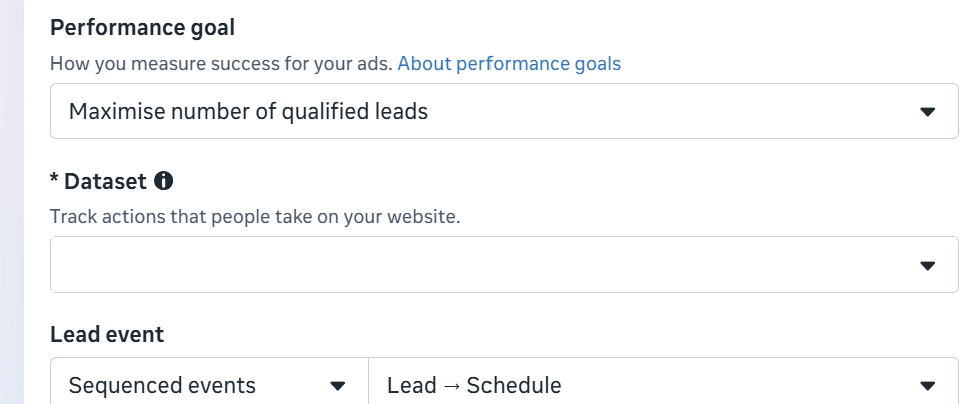
This is how it looks in Ads Manager in the accounts I run:
- Create a Leads campaign.
- At the ad set level, set the conversion location to your website.
- Set the performance goal to Maximise number of qualified leads.
- Choose your dataset.
- Under Lead event, choose Sequenced events.
- Set the sequence to Lead, then Schedule.
Here's the ad set in one of my client accounts, with the dataset name hidden:
Everything else stays how I'd normally run it. One ad per ad set, each with its own budget, so every ad gets a fair test.
How I judge ads on sequenced events
I judge them on cost per booked call, not cost per lead. Leads still matter, because they show you where people drop off. But the booked call is what you're paying for. I explain which metric I actually judge a lead gen ad on in this video.
I give these ads five days instead of four. A booked call costs more than a lead, so it takes longer to see enough of them. Your unit economics decide how long you wait.
Then I check the CRM. Did those calls turn into sales, and how much cash was actually collected? That's what tells you whether an ad is a winner.
What sequenced events won't fix
It's a better signal, not a better ad.
Your ad still does the targeting. If it attracts people who can't afford you, they won't book, and Meta has less to learn from. If it calls out the right buyer and gives them a reason to trust you, sequenced events helps Meta find more people like the ones who booked.
It also won't fix broken tracking. If your Schedule events don't reach your ad account, or they can't be matched to the right person, there's nothing to optimise for.
How to test sequenced events against lead optimisation
Don't rebuild a campaign that's already working. Test sequenced events in new ad sets, using ads you've already proven.
I tell clients to keep about a tenth of their monthly ad budget for experiments like this, or to add it on top. A new optimisation event is exactly what that buffer is for. Run it with the same ads, landing page and copy, so the event is the only thing that's different.
Then compare cost per booked call, and what each customer cost, over the same stretch of time. If it wins, give it more budget.
FAQ
What are Meta's sequenced events?
A setting that lets Meta optimise for two events in order, usually a lead and then a booked call. An ad only gets credit when the same person does both, in that order.
Do sequenced events lower your cost per booked call?
In the accounts I've used them on, yes. In one account in October 2026, lead optimisation cost $264 per booked call and sequenced events cost $160, side by side with the same ads. Customer acquisition cost fell 12%.
Why can't I see sequenced events in Ads Manager?
Some accounts don't have it yet. Others need to send more booked call events back to Meta before it shows up. It sits on website ad sets with the Maximise number of qualified leads performance goal.
Do I need the Conversions API for sequenced events?
I'd use it. Meta can only optimise for booked calls it can see and match to the right person. The account I've shared sends both events through the pixel and the Conversions API.
Should I judge ads on cost per lead or cost per booked call?
Cost per booked call, then what each customer costs. Leads still matter, because they show you where people drop off, but the booked call is what you're paying for.
How long should I run an ad on sequenced events before judging it?
I give these ads five days instead of four, because a booked call costs more than a lead. Your unit economics decide how long you wait.